

GTA 6 on PS5 and PS5 Pro — Why 30 FPS Is a Fair Price for Such an Open World
 Rodion Ilin
On November 10, 2026, nine days before release, Rockstar made an announcement that many took as a slap in the face: GTA 6 will run at 30 frames per second on all consoles. This limitation also affected the PS5 Pro, which Sony was selling specifically as a console for "heavy" games. There was no word about a 60 FPS mode in the statement, and the studio later confirmed to Kotaku that there would be neither 60 nor 40 frames. The comments under the news quickly split into two camps: some decided that Rockstar simply failed with optimization, others felt that frame rate in a story-driven game isn't that important.
What makes it more interesting is that Digital Foundry, which is pickier than anyone else about counting frames, called GTA 6 a milestone for an entire console generation. In John Linneman's analysis, 30 FPS is called not a failure, but a deliberate compromise. If that's the case, the debate about frame rate will repeat itself more than once: other studios will also start sacrificing smoothness for the density of the world, and the argument "it's Rockstar" will stop being an exception.
I want to figure out exactly what Rockstar gained in exchange for half the frames, and whether this deal was worth it.
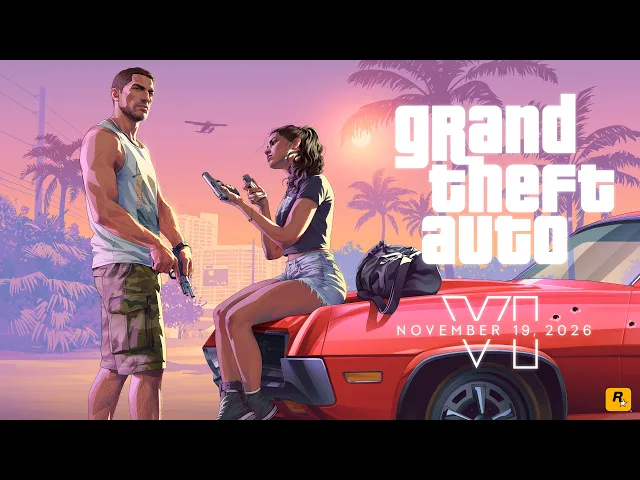
Two Consoles, One Resolution
Let's start with what's argued about the loudest, because both Sony consoles render GTA 6 at the same resolution of 2560×1440, that is, 1440p, and the difference only appears at the next step. The PS5 Pro runs the image through PSSR, Sony's neural upscaler, and produces an image that is hard to distinguish from true 4K on a TV. The regular PS5 stretches those same 1440p using a classic spatial method, so the picture looks softer, and distant details like wires and signs are noticeably blurry.
The story with stability is similar, and on the PS5 Pro, according to Digital Foundry's measurements, 30 frames hold rock-solid with perfect frame pacing: each frame is output at equal intervals, so the low frame rate doesn't turn into a stuttery mess. The base PS5 also holds the line during a normal walk around the city. However, at high speed the frame rate drops slightly, and a prolonged firefight with lots of explosions can lower it to about 25 frames.
The second difference in the Pro version concerns shadows. On the PS5 Pro they are calculated using ray tracing, on the regular console — with classic shadow maps. But to understand why even the Pro couldn't handle 60 frames, you need to look not at the graphics card.

The Bottleneck Is the CPU, Not the Graphics
In a conversation with Kotaku, Rockstar explained why it refused even a 40 FPS mode. According to the studio, the PS5 Pro's processor is only slightly faster than the regular PS5's, and it's not enough to calculate the game's complex simulation at a higher frame rate. The upscaler and ray tracing can be improved with GPU power, but thousands of pedestrians, cars, and police officers, each with their own logic, fall on the CPU. You can't remove this load with a new graphics card.
Digital Foundry warned back in the summer that 60 FPS in GTA 6 is unlikely to appear even on PS5 Pro, and cited the same reason. Now another argument has appeared in their review: GTA 6 has technologies that other studios only allow themselves for the main character.
Take hair, for example — usually only the protagonist gets strand physics, while everyone else makes do with a "helmet" of polygons. In GTA 6, every passerby's hair is rendered with strands, and they react to wind, movement, and water. Digital Foundry directly calls such a system across an entire city one of the reasons why 60 frames on current hardware turned out to be impossible.
The Best Ray Tracing of the Generation
On all consoles, GTA 6 uses ray tracing for global illumination and for reflections on both smooth and rough surfaces. Digital Foundry calls this perhaps the best implementation of RT to date, and the main difference here is not in the number of effects. In games on Unreal Engine 5, ray tracing often gives itself away with noise, flickering, and "swimming" reflections. In GTA 6 there are almost no such artifacts, because the lighting was built together with the artists' work from the very beginning, rather than bolted on top.

This is especially noticeable in rooms where light doesn't come in directly. Tinted glass colors the light passing through it and casts colored shadows inside the building. Materials honestly show dirt, dust, wear, and refraction in glass. Flaws do occur, and on rough metal, for example on elevator doors, denoiser noise and layers of screen-space reflections sometimes appear. But overall, indirect lighting looks so good that Digital Foundry speaks of an almost photorealistic picture.
The sky has also become a separate technology, where a physically correct atmosphere and procedural volumetric clouds grew out of the Red Dead Redemption 2 system. The weather is local, so you can stand in the sun and watch a thunderstorm gather over a neighboring district, cover it in shadow, and pour rain over several blocks. In HDR, brightness peaks exceed 1500 nits, so the difference between the blinding Florida sun and deep shadow feels almost physical.

However, many can draw a beautiful sky. Much rarer is a city that looks built rather than drawn.
A City That Looks Like Street View
Vice City and the surrounding state of Leonida are the largest map in Rockstar's history. Usually size and detail get in each other's way: the bigger the world, the more often you come across empty areas and identical blocks. Here Digital Foundry notes the opposite: the map is simultaneously the largest and the densest.

The architecture, interchanges, shopping centers along the highway, and coastal boulevards are placed the way an urban planner would place them, not a game designer. Linneman describes the eerie feeling of looking not at a game, but at Google Street View images. The transitions between levels of detail are invisible: all the way to the horizon you can see the movement of cars, crowds of people, and working streetlights, while major highways in the distance are discernible by chains of headlights.
Try to remember the last time you were chased off a roadway in an open world. With Digital Foundry this happened while the editorial team was setting up a shot for a screenshot: the police yelled at them because people were standing in the middle of the road. It seems that in Leonida even a photo shoot requires coordination.
But the surroundings are just decoration. The main thing in GTA 6 happens where the city starts reacting to the player.
The Simulation It Was All Made For
This is exactly where it becomes clear where the processor's power goes. You can interact with almost any passerby through a context menu: say hello, talk, or threaten. Residents have their own lines and personality traits. After an accident they start quarrels themselves, and during a shootout on the street they hide in nearby stores.

The police no longer appear out of thin air at the moment of a crime. Patrols drive out from real stations on the map, pursuit begins only after an officer has seen the suspect, and when storming a building, police enter through back entrances. They recognize the player by clothing, car, and the weapon in hand, so changing clothes or swapping cars is a working way to escape pursuit.
The damage model has also become more detailed, and a wounded enemy limps, drops their weapon, or falls clutching a specific wound instead of a standard death animation. In an indoor firefight, bullets smash furniture and pierce bottles and cans, from which liquid of the correct color leaks out, and the faster the more holes there are in the container.
There are so many everyday details that they would be enough for a separate life simulator:
- food and drinks can be bought in a store or vending machine, taken from the home fridge, and the packaging thrown in a trash can or right on the floor;
- TV shows its own programs, sports broadcasts, and commercials;
- Jason and Lucia have a console at home with surprisingly deep games;
- ATM screens are covered with protective shutters that hide the numbers if you look from the side;
- cars are stolen in different ways, from hotwiring to cloning a key, they have fuel that needs to be filled at gas stations, and dents on the body change handling.
You could call all this excess, but such details are what create the feeling that the city lives without the player. But this liveliness also has another side, which Digital Foundry doesn't stay silent about either.
Racing and One Caveat
Outside the city, Rockstar has set up a real motorsport scene. The Thrillbilly Mud Club hosts races on motocross bikes and SUVs over deformable mud, and besides them there are street leagues, survival derbies, and circuit tracks. The handling feels like something between the heavy cars of GTA 4 and the responsive ones of GTA 5. Digital Foundry even compares the car physics here to Gran Turismo and Forza. For a series where you can still flip a car back onto its wheels by rocking it, that's a bold statement. A heat haze shimmers over the scorching asphalt.
Now the caveat: 30 frames don't disappear just because everything around is beautiful, and control response remains a weak point, and Digital Foundry directly writes that such a frame rate gets in the way of absolute responsiveness. Some critics who gave the game high scores also criticize the controls.
The main question remains: do the money and years of development justify this result.

Digital Foundry doesn't deny that 30 FPS is a compromise, but what matters far more is what exactly it was traded for. Rockstar gave up smoothness for ray tracing without artifacts, a city without empty blocks, and a simulation in which police search for you by description and a pierced bottle leaks depending on the number of holes. A deal that looked like an optimization failure turned out to be a conscious choice. Apparently, in this generation, "better" and "smoother" have finally stopped meaning the same thing.
Personally, I'll add: if GTA 6 really sets the bar for open worlds for years to come, then we'll most likely see the first 60 frames in Leonida not on PS5 Pro, but on PC or PlayStation 6. The only question is how much longer you're willing to wait.
Sobre o GTA 6
- Guia de Pré-Venda de GTA 6: Preço de R$80, Edições e Todos os Bônus
- GTA 6 — Tudo o que sabemos: data de lançamento, preço, trailers, mapa, personagens e jogabilidade
- Todas as capas de GTA — do primeiro jogo ao GTA 6. Vote na sua favorita
- Tudo que Você Precisa Saber Sobre o Escândalo de Demissões da Rockstar Games
- O que foi mostrado no segundo trailer de GTA 6 — análise e novidades
- Supostas imagens de GTA 6 surgem na internet: analisamos o vazamento (atualizado)
- Os vazamentos do GTA 6 e uma criptomoeda: como funciona o esquema CYBERLEEK
- Polêmicas de GTA: processos, proibições e Hot Coffee
- GTA 6 na Game Informer: tudo o que você precisa saber sobre Leonida — furacões, mais de 170 espécies de animais e um mapa com o dobro do tamanho de GTA 5
- Mundo, personagens e sátira de GTA 6: principais revelações da entrevista da Rockstar à revista LOVE
- Missões, relacionamentos e sistemas criminais de GTA 6: principais revelações da entrevista da Rockstar à IGN
- Campanha de marketing de GTA 6: um letreiro de US$ 975 mil em Vice City e um jogo do Miami Heat
- A longa jornada de GTA 6 até o lançamento: principais conclusões da reportagem da Bloomberg
- Análise do trailer de lançamento de GTA 6: os detalhes mais interessantes
- Guia de pré-download de GTA 6: tamanho do arquivo, horário de lançamento, edições e PS5 Pro
- Sistema de combustível, noites mais longas e cães policiais em GTA 6: principais detalhes da prévia da EDGE
- Iates, perseguições e tiroteios — o que a galeria de lançamento de GTA 6 revelou
- Pré-carregamento disponível e 30 FPS — detalhes do novo trailer de GTA 6 e requisitos atualizados para PC
- Jogo ou realidade? Como dois vídeos de GTA 6 fizeram os críticos esquecerem os 30 FPS
- O melhor jogo já feito? O que a crítica está dizendo sobre GTA 6
- GTA 6 on PS5 and PS5 Pro — Why 30 FPS Is a Fair Price for Such an Open World